Introduction
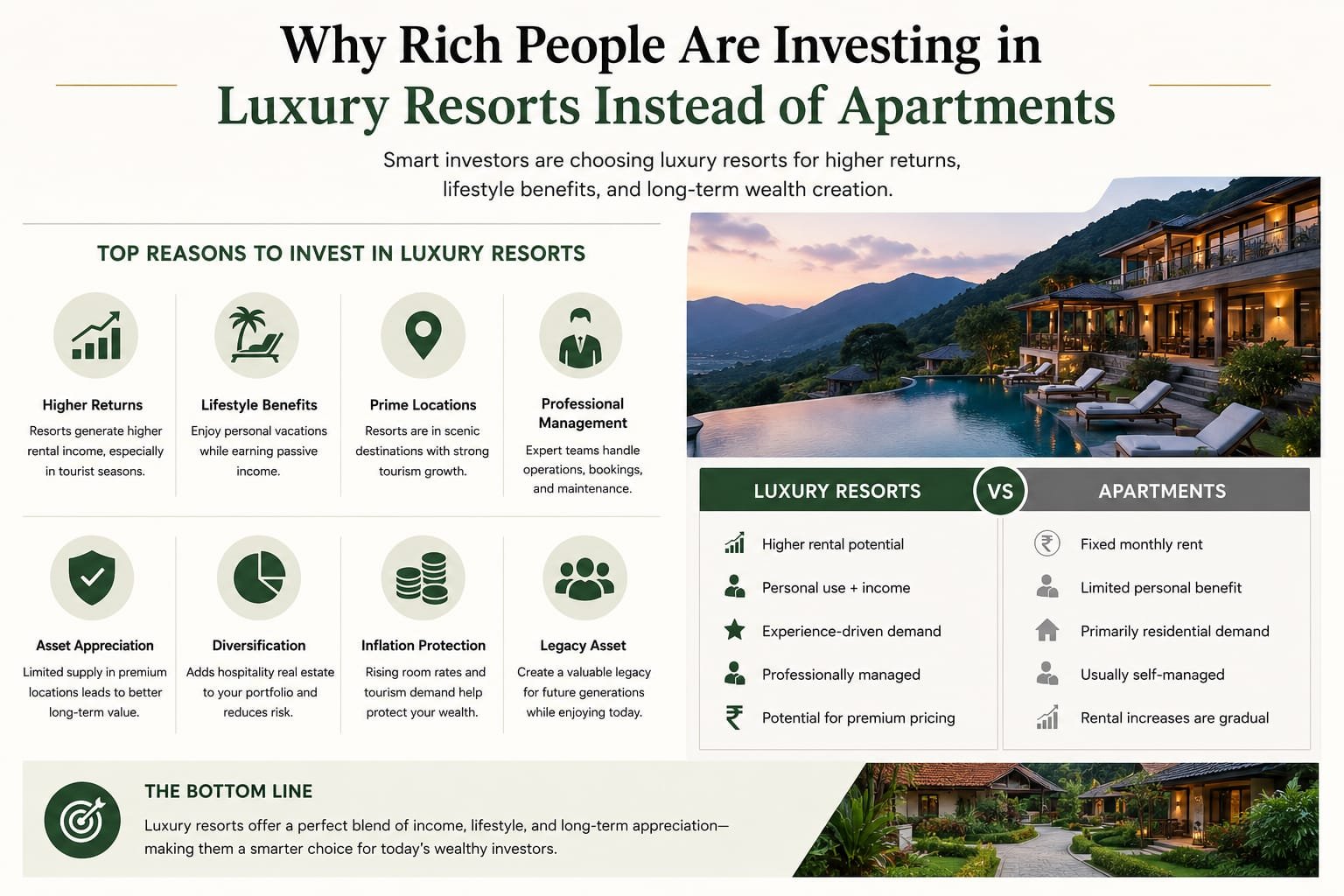
The real estate industry is undergoing a major transformation while residential and commercial properties continue to attract investors, a new investment category is rapidly gaining popularity -managed hospitality assets.
From luxury resorts and holiday villas to serviced apartments and vacation homes, hospitality-based real estate investments are offering investors an opportunity to generate passive income while benefiting from the growth of the tourism sector.
with domestic and international tourism increasing every year, resort property investment have emerged as an attractive option for those seeking stable returns, professional property management, and long- term capital appreciation
This article explores how resort property investments work, how investors earn returns, and the key factors that influence Return on Investment
Understanding resort property investment
Resort property investment involves purchasing a unit within a hospitality project, such as;
- Resort rooms
- Luxury villas
- Holiday cottages
- Vacation homes
- Serviced apartments
Unlike traditional rental properties, these assets are professionally managed by a hospitality operator;
- Guest booking
- Customer report
- Property maintenance
- Revenue management
- Housekeeping services
- Marketing and advertising
As a result, investors can earn income without dealing with daily operational challenges.

What is ROI in Resort Property Investment ?
ROI ( Return on Investment ) measures the profitability on investment.
It helps investors understand how much income they are earning compared to the amount invested.
Basic ROI Formula
EXAMPLE
Suppose an investor purchases a resort villa for ₹50 Lakh
- Annual rental income
- Annual maintenance expenses
- Net income
ROI=10%
A higher ROI generally indicates a more profitable investment

How Investment Earn Through Managed Hospitality Assets
1 Rental Income from Guest Stays
The primary source of income is revenue generated through guest bookings
Whenever tourists book rooms, villas ,or cottages, income is generated
Unlike residential properties that typically have one talent , hospitality properties can generate income from hundreds of guests throughout the year
Example
- Average room rent = ₹6,000 per night
- Occupancy = 60%
- Revenue generated throughout the year
- Investor receives an agreed percentage after management fees
- This is the primary source of income in managed hospitality assets
Revenue Sharing Model
Many resort projects operate on a revenue-sharing basis.
Example:
- Resort earns ₹10 lakh from bookings.
- Operator keeps 40%.
- Investor receives 60%.
The percentage varies from project to project.
3. Fixed Assured Returns
Some developers offer assured returns for a limited period.
Example:
- Investment = ₹40 lakh
- Assured return = 8% annually
- Investor receives ₹3.2 lakh per year
Always check the legal agreement and sustainability of such promises.

4. Property Appreciation
The property’s value may increase over time due to tourism growth, infrastructure development, and increasing demand.
Example:
- Purchase price = ₹50 lakh
- Value after 5 years = ₹70 lakh
Capital appreciation = ₹20 lakh
Benefits of Managed Hospitality Assets
✔ Professional Management
Investors do not need to:
- Find guests
- Handle bookings
- Manage housekeeping
- Deal with maintenance
The operator manages everything.
✔ Passive Income
Income can be generated without daily involvement.
✔ Personal Usage
Many projects allow owners to stay for a certain number of days each year.
✔ Tourism Growth
Properties in popular destinations often benefit from increasing tourist arrivals.
Factors Affecting ROI
Occupancy Rate
Higher occupancy generally means higher income.
Average Daily Rate (ADR)
The higher the room tariff, the greater the potential revenue.
Location
Tourist destinations with strong demand usually perform better.
Examples:
- Manali
- Goa
- Rishikesh
Management Quality
A strong hospitality operator can improve occupancy and guest satisfaction.
Seasonality
Many resorts earn more during peak tourist seasons and less during off-seasons.
Risks to Consider
- Low occupancy during economic downturns
- High maintenance costs
- Dependence on tourism trends
- Delays in project completion
- Overly optimistic return projections
Investors should review legal documents, operator agreements, and historical occupancy data before investing.
Conclusion
Managed hospitality assets generate returns through:
- Rental income from guests
- Revenue sharing with the operator
- Assured returns (where applicable)
- Long-term property appreciation
A well-located resort with strong management can provide both passive income and capital growth, but actual ROI depend heavily on occupancy rates operating costs and tourism demand. however if you are looking for sustainable resort investment in Nainital, you can consider Urban Arbor Pangot project offering 12% AR.